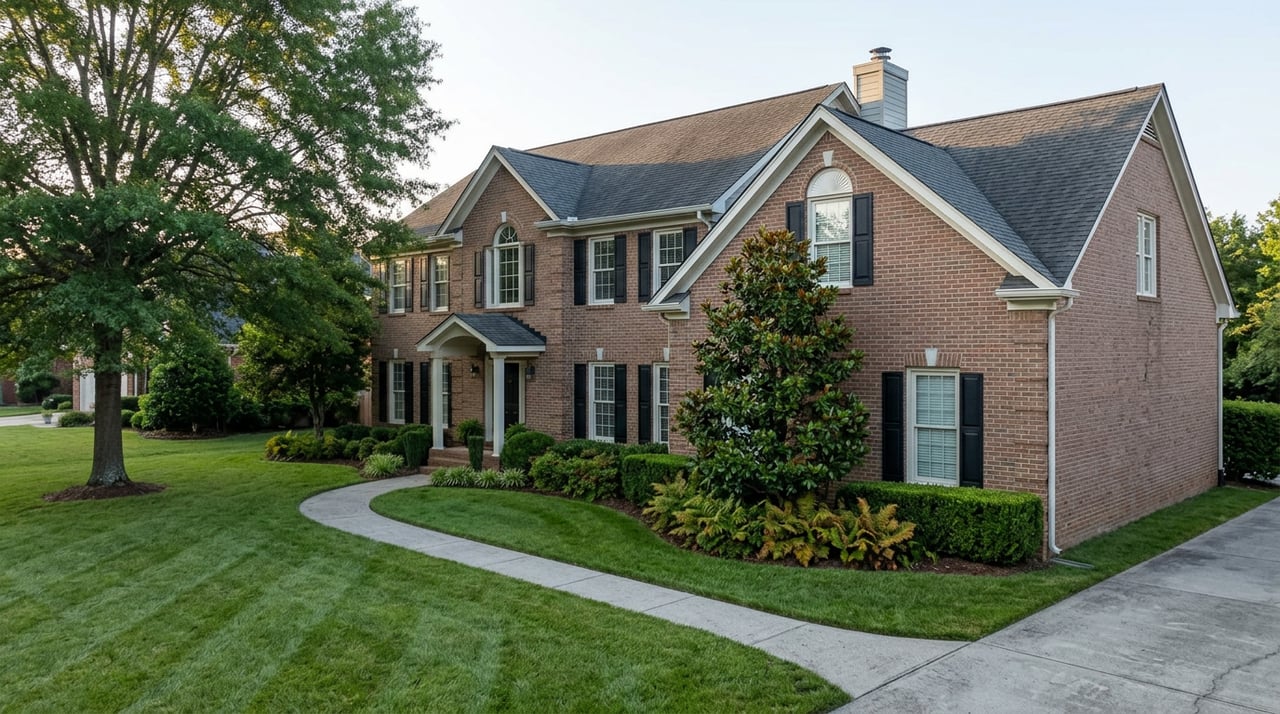
Everyone selling a move to Fort Mill leads with the same line: cross into South Carolina and your property tax bill drops. It's true in a lot of places around here. It is not true inside Fort Mill itself.
Buyers who target the actual town limits of Fort Mill, or its sister city Tega Cay, are landing on an effective property tax rate close to 0.95 percent once York County's 2025 millage levies are applied. That is higher than Union County, North Carolina, and close enough to Mecklenburg County's roughly 0.80 percent rate that the celebrated "no state income tax and lower property tax" pitch stops doing much work. The real discount sits a few miles away, in unincorporated York County, Lake Wylie, and the parts of Rock Hill outside city limits, where the same math lands closer to 0.50 to 0.66 percent. Buyers who assumed the savings and the school district came as a package deal are actually choosing between them.
The Ring Nobody Draws on the Map
Property tax in this corner of the Carolinas is not one number that flips at the state line. It stacks by jurisdiction, and every layer, county, municipality, and school district, adds its own rate on top of the last.
| Location | Approximate effective property tax rate |
|---|---|
| Fort Mill / Tega Cay (inside town limits) | ~0.95% |
| City of Rock Hill | ~0.86% |
| Mecklenburg County, NC (Charlotte) | ~0.80% |
| Union County, NC | ~0.72% |
| Unincorporated York County, Lake Wylie, Rock Hill outside city limits | ~0.50%–0.66% |
| Lancaster County, SC (Indian Land) | ~0.45%–0.50% |
Look at where Fort Mill sits on that list. It is not the bargain. It is the most expensive line in the entire table, ahead of the North Carolina county most buyers were trying to escape.
There is a structural reason South Carolina's owner-occupied assessment still helps: under the state's Act 388, a primary residence is assessed at 4 percent of value and exempted from the school district's operating millage, while a Charlotte home is taxed on its full value. That structure is real and it does keep South Carolina's math friendlier than the headline rate alone would suggest. But once you're inside Fort Mill's own boundary, the town and school district levies on top of that structure erase most of the advantage that made the move look obvious on paper.
What the Extra Tax Actually Buys
So why does Fort Mill still command a housing premium over the rest of York County and over the broader Charlotte metro, where the median home price ran roughly $415,000 to $435,000 in spring 2026 against Fort Mill's own $490,000 to $530,000 band over the same window?
The Fort Mill School District earned Niche's number one ranking among all South Carolina districts for 2026, the top spot in the Charlotte metro, and a national rank near 91st out of more than 10,000 districts, putting it in the top one percent nationally. The district's on-time graduation rate runs 95.7 percent against a state average of 85.4 percent, and its average SAT composite of 1116 sits 108 points above South Carolina's statewide average. Homes zoned to Nation Ford High School, one of three high schools in the district alongside Fort Mill High and Catawba Ridge High, have been selling for 15 to 20 percent above comparable properties outside that boundary.
That premium is what buyers are actually purchasing when they pay up to live inside Fort Mill's town limits. It is not the tax bill. The tax bill, once you're inside the line, looks a lot like the one you left in Mecklenburg County.
New construction adds one more layer buyers routinely miss. Every new single-family home built inside the Fort Mill School District, which reaches into parts of Tega Cay, carries a school impact fee of $29,640 per unit. That fee applies to the new build down the street, not to the resale next door, so a straight price comparison between a new home and an existing one in the same neighborhood is already off by nearly $30,000 before either side factors in lot premiums or design center upgrades.
The Line at the Building Department
Right now, the supply side of this market has its own complication. Fort Mill Town Council adopted a temporary moratorium on new residential rezoning and annexation applications on March 31, 2026, through Ordinance 2026-19. It runs through September 30, 2026, with a possible 90-day extension, and it is the second such pause the town has enacted in under a year, following one that ran through the end of 2025 while the town finished its Our Path Forward comprehensive plan and a new downtown master plan.
The moratorium does not touch projects that already have approval, so homes already under construction or already zoned are not affected. What it does is freeze the pipeline of new residential land coming into the process while the town aligns its ordinances to the plans it just adopted. Local business owners have been vocal about wanting the pause to protect the town's character as it grows. Vestique's Olivia Miles and Olive's Mud Puddle's Paul Whitsett both spoke publicly in support of the town slowing down to preserve what NeedleWorx Studio owner Bianca Miller and others describe as Fort Mill's small-town feel even as its population has more than tripled over the past decade.
For a buyer watching the market right now, that means the new-construction inventory you tour this fall is largely what already cleared approval before March. Fewer new subdivisions are entering the pipeline behind it until at least late September, which tightens the supply of the exact new-build product that carries that $29,640 fee on top of its base price.
Where the impact fees already collected are going is visible two days ago. Fort Mill broke ground on its third fire station on August 27, 2026, a 10,000-square-foot facility at 1655 Masons Bend Drive built by Rock Hill-based Leitner Construction and funded through the town's impact fee trust, on land donated as part of the Masons Bend neighborhood's development agreement. Fire Chief Chipper Wilkerson noted that better firefighter and EMT distribution across town can improve local ISO ratings, the scale insurers use to help set homeowners insurance rates. A better rating from a new station is a small, real number that could show up on a resident's insurance bill down the road, separate from anything on the property tax statement.
The Paperwork That Doubles Your Bill
The 4 percent primary-residence assessment that makes South Carolina's structure workable only applies if you file for it. Buyers who close on a South Carolina home and forget to apply for the owner-occupied classification get taxed at the 6 percent rate reserved for investment property, which can more than double the bill. It is one form, filed with the county assessor, and it is the single most common paperwork miss among relocating buyers on this side of the state line.
South Carolina also charges an annual vehicle property tax, paid to the county before you can renew registration, and it runs higher than North Carolina's combined Tag and Tax Together system on comparable vehicles. For a household with two or three cars, that yearly bill can offset a meaningful slice of whatever property tax savings the address actually delivers. None of this makes the South Carolina side a bad decision. It makes the decision a math problem specific to the parcel, the school zone, and the driveway, not a rule of thumb that applies the moment you cross a bridge.
Where This Leaves a Buyer
If the goal is the number one school district in South Carolina, Fort Mill or Tega Cay is still the address, and the property tax bill you'll pay there is closer to Charlotte's than to the discount everyone promises. If the goal is the tax savings itself, unincorporated York County, the Lake Wylie shoreline, outer Rock Hill, or Lancaster County's Indian Land corridor deliver the lower rate the pitch describes, often with a shorter commute into Ballantyne than Fort Mill offers into Uptown. Both are legitimate reasons to buy on this side of the state line. Treating them as the same reason is where buyers get the math wrong.
Working both sides of this border for a living means walking a buyer through the actual jurisdiction, the actual millage, and the actual school zone line for a specific address before an offer goes in, not after closing. Nick Sells Carolinas holds dual North Carolina and South Carolina licensure built for exactly this kind of comparison. Start your search, and let's run the real numbers for the parcel you're considering.
FAQ
Does buying in Indian Land avoid Fort Mill's town tax rate entirely? Indian Land sits in Lancaster County, not York County, and carries its own rate, roughly 0.45 to 0.50 percent, which is lower than either Fort Mill town limits or unincorporated York County. It feeds into the Lancaster County School District rather than Fort Mill's, so the trade is a lower tax bill against a different school system.
What happens if I miss the primary-residence filing deadline in South Carolina? Your property gets assessed at the 6 percent non-owner-occupied rate instead of 4 percent, which can more than double the annual bill until the classification is corrected. The filing goes through the county assessor's office and is worth confirming at closing, not after the first tax bill arrives.
Will the current moratorium affect homes already listed for sale in Fort Mill? No. The pause applies only to new applications for rezoning, annexation, or development approval submitted after March 31, 2026. Homes already built, already zoned, or already under construction move through the market as usual.
